Quick Answer: Yes, outsourcing graphic design is worth it once you have an established business with consistent design needs. It gives you access to strategic creative expertise, brand consistency, and faster turnaround without the overhead of a full-time hire. For early-stage businesses on a tight budget, AI tools and templates are a reasonable starting point.
You already know something is off.
The AI-generated designs feel flat. The Canva templates look like everyone else’s. You’ve tried a freelancer or two from a job board, and the results were fine, not wrong, exactly. Just not right.
So you keep tinkering. Adjusting. Wondering if there’s a faster, cheaper way to just make it work.

There isn’t. And deep down, you probably already know that.
This article is for the business owner or marketing lead who’s tired of design that looks good enough but doesn’t actually do anything. You’re not here to be sold on outsourcing. You’re here to get clarity on whether it’s actually worth it, and what it looks like to do it right.
Who This Guide Is For
- Business owners with an established product or service who are scaling their marketing
- Marketing managers spending too much time chasing inconsistent freelancers
- Founders who’ve outgrown Canva and AI tools but aren’t ready to hire in-house
- Companies looking to outsource graphic design to a Philippines-based studio without sacrificing quality
Can’t AI Just Handle This Now?
It’s a fair question. AI design tools have gotten genuinely impressive. You can generate an image in seconds, put together a social post with an AI layout suggestion, or get a logo draft from a text prompt.
For a business that’s still testing the waters, still figuring out product-market fit, still working with almost no budget, that’s actually fine. Use what you have. Get moving. Don’t over-invest in branding before you know what you’re building.
But here’s where it breaks down.
AI tools can only work with what you give them. They pull from what already exists: the most common imagery, the most familiar patterns, the visual language that’s already saturating your market. The result isn’t bad, exactly and it’s generic. Forgettable. Safe in a way that doesn’t actually keep you safe at all.
When a client comes to us after relying on AI-generated design, we usually see the same pattern: no clear visual hierarchy, no consistent identity, no sense of who the brand is or who it’s for. The individual pieces might look okay in isolation. Together, they don’t add up to a brand, they add up to noise.
Noise doesn’t build trust. It erodes it.
A real example: One client came to us with a logo they’d generated using an AI tool. It felt modern, clean, polished. But when we reviewed it together, the problems became clear quickly: it was too complex to scale to a business card or favicon, the visual metaphor was already overused in their industry, and there was nothing distinctive enough to make someone remember the brand a week later. The AI had no way to flag any of that, because it had no idea what the brand was actually trying to accomplish.
The core limitation: AI doesn’t know your audience, your positioning. It can’t tell the difference between what looks professional and what is professional in your specific market. Yes, it can generate options quickly but it cannot think strategically.
What Does Professional Graphic Design Do That AI Can’t?
The real value of professional branding and marketing design isn’t in the output. It’s in the strategic thinking behind it.
Here’s a real example: A pest control brand called QureIt came to us needing a rebrand. Their existing identity looked outdated and generic. They knew what they didn’t want. When we asked what they did want, the answer was ‘modern, clean, and professional.
Those are reasonable words. They’re also nearly useless as a creative brief, because they describe half the brands in any given industry.
If we’d taken those words at face value, we might have landed somewhere in the ‘modern and serious’ zone that most of their competitors already occupied, something that looked fine on screen but did nothing to differentiate them. Safe. Forgettable.
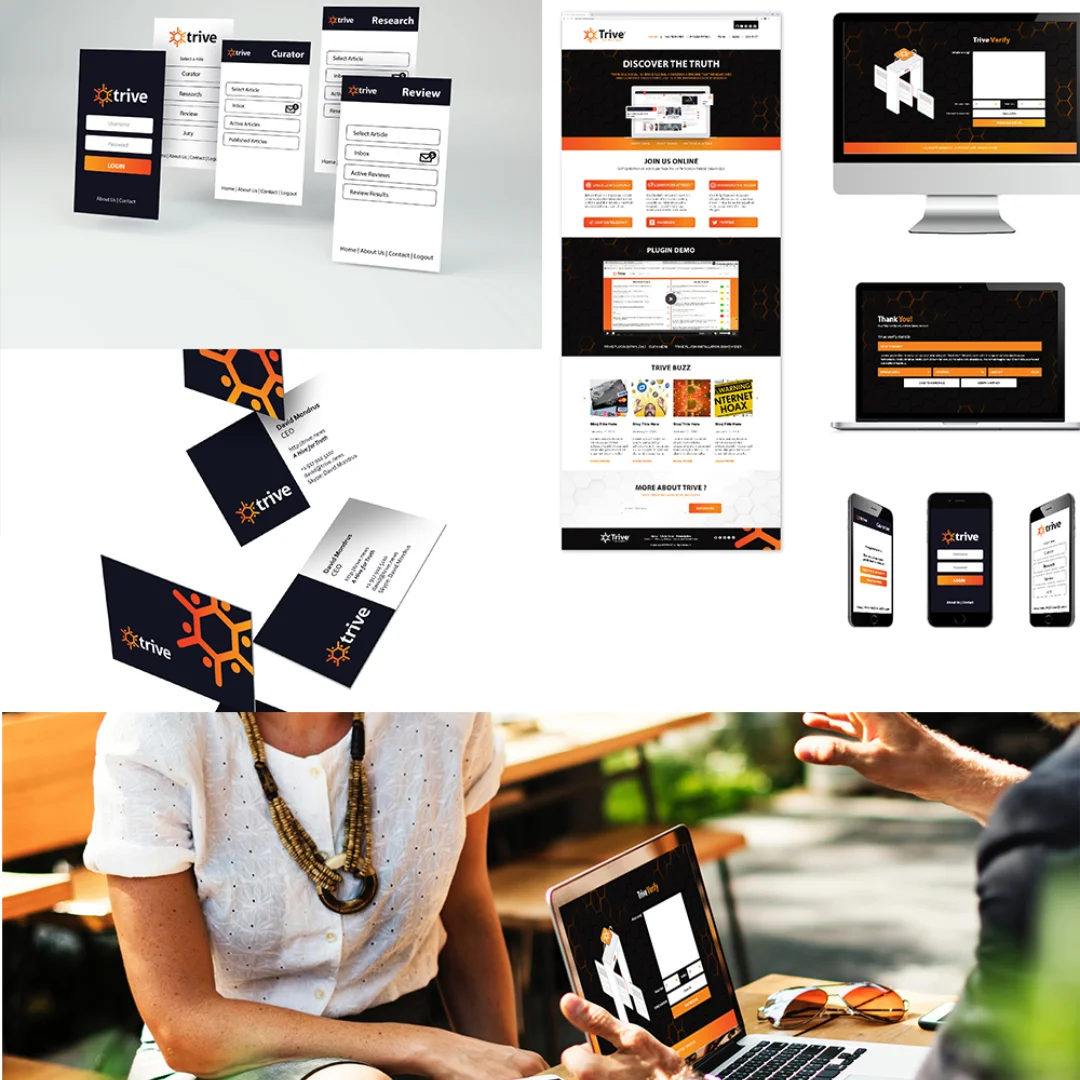
Instead, we ran them through our brand discovery and strategy process. What emerged was something more specific and more useful: QureIt’s strongest positioning wasn’t modern-and-serious. It was modern-and-friendly, a brand that matched their use of eco-friendly materials and their more approachable take on pest control, standing out clearly against a saturated market full of severe, industrial-looking competitors.
They didn’t just end up with a new logo. They ended up with clarity about who they are, what they stand for, and how to communicate it. Not because we made it look good, because we made it mean something.
An AI prompt can’t get you there. A Canva template can’t get you there. Even a capable freelancer working without a strategic framework probably won’t get you there.
Freelancer vs. In-House Designer vs. Design Agency: What’s Actually Better?
Here’s a direct comparison of the three most common approaches businesses use for ongoing design work:
Freelancer
- Lower cost per project
- High inconsistency between projects, different freelancers = different quality
- No brand knowledge retention between jobs
- Works for one-off tasks; breaks down for ongoing brand building
In-House Designer
- Full brand knowledge, always available
- High overhead: salary, benefits, equipment, software licenses
- Limited by one person’s skill set and bandwidth
- Makes sense at scale, usually $60k–$90k+ all-in per year

Outsourced Design Studio (like Pugo)
- Access to a full team across strategy, branding, and execution
- Brand knowledge retained and built over time, like in-house, without the overhead
- Consistent output across every touchpoint
- Scales up or down with your needs
- Strategic input on every project, not just task execution
What About Outsourcing Specifically: Shortcut or Smart Move?
There’s a version of outsourcing that is absolutely a shortcut, and it usually ends badly. That’s the version where you hand off a vague brief to the cheapest option available, hope for the best, and end up spending more time on revisions than you saved by not hiring in-house.
But that’s not what outsourcing has to be.
The biggest misconception we hear is that outsourcing is just about getting execution done, that it’s a production service, not a creative partnership. And to be fair, a lot of outsourcing arrangements are exactly that. You submit a ticket, you get a file back, nobody thinks about whether it’s actually right for your brand.
That’s not the kind of outsourcing worth paying for.
What actually works, and what we’ve seen work consistently over more than a decade working with brands across the US, Australia, and beyond, is when a client comes in understanding that they’re not just buying design tasks. They’re buying an ongoing creative relationship with a team that already knows their brand, brings strategic input to every project, and can be trusted to get it right without being micromanaged.
That kind of relationship changes how you operate. Your marketing manager stops spending half their week chasing freelancers and reviewing inconsistent work. Your brand starts to look and feel consistent across every touchpoint. Design stops being a problem to solve and becomes a lever you can actually pull.
What Makes Outsourcing Work And What Causes It to Break Down
After over a decade of working as a creative partner for brands in the Philippines, US, and Australia, we know what separates the relationships that work from the ones that quietly fall apart.
The outsourcing relationships that work well share these traits:
- The client values consistency and understands that brands are built through repetition and coherence, not through one great campaign
- They trust the expertise of the people they’ve hired and don’t second-guess every decision
- They see design as a strategic asset, not a commodity task
- They’ve decided that having their design in good hands is worth more than the illusion of control
The relationships that break down usually come from the opposite:
- Clients who treat every deliverable like it needs to be renegotiated from scratch
- Clients who haven’t bought into their own brand standards
- Clients who want to do the creative thinking themselves and just need someone to execute, that’s a different kind of engagement and it rarely produces great work
When Is Outsourcing Graphic Design Worth It and When Isn’t It?
Let’s be direct, because not every business is ready for this.
Not ready yet: If you’re still testing a business idea with almost no budget, outsourcing professional design probably isn’t your priority. Use the tools available to you. Get to market. Figure out what you’re building.
Ready now: Once you have an established market fit, once you’re growing, once you’re competing seriously, once you’re asking people to trust you with their money, the game changes. At that point, what your brand looks like and how consistently it shows up is directly tied to whether people take you seriously. Whether they see you as a professional or a commodity. Whether they remember you or forget you the moment they close the tab.

That’s when investing in professional branding and marketing design stops being optional and starts being the thing that either accelerates your growth or quietly limits it.
Outsourcing that work to the right partner, one with the experience, process, and strategic depth to actually move the needle, means you can focus on running and growing your business.
Instead of managing a full-time design hire with all the overhead that comes with it, or juggling multiple freelancers with inconsistent results, you have one reliable creative partner who already knows your brand and is ready to deliver.
Take a look at our graphic design retainer packages to see what that looks like in practice.
Less stress. More results. And a brand that finally works as hard as you do.